Free Trade Agreements and Market Access — Overview
Opportunities for European Companies in India’s Pharmaceuticals, APIs & Specialty Chemicals Sector Post EU–India FTA
By Nagavarapu Sudheer, M.Com, F.C.S, L.L.B Partner, A2 Consultants
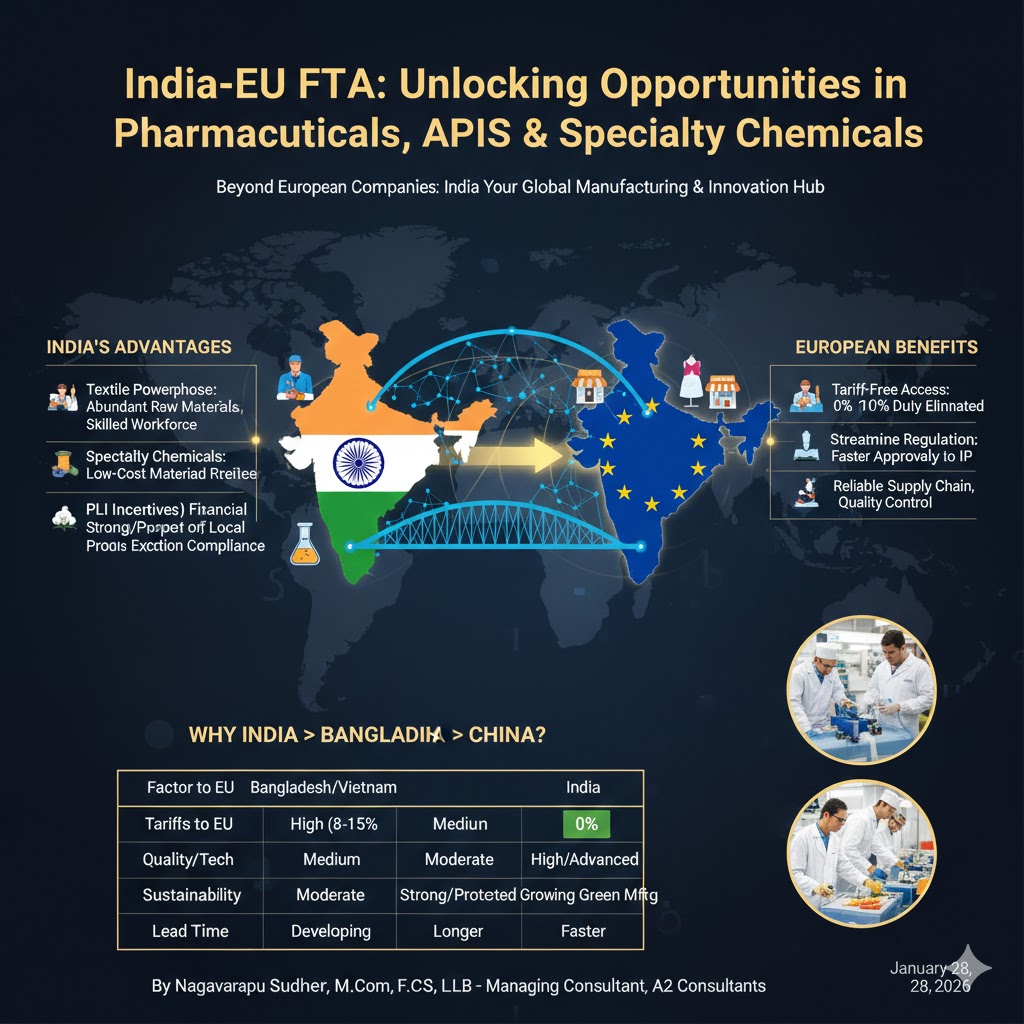
The proposed EU–India Free Trade Agreement (FTA) is expected to reshape global supply chains in critical sectors such as pharmaceuticals, active pharmaceutical ingredients (APIs), and specialty chemicals. As Europe seeks supply security, cost efficiency, and regulatory-aligned partners, India emerges as a natural strategic destination for European companies.
India already plays a vital role in Europe’s healthcare and chemical supply ecosystem. With the FTA reducing tariffs and easing regulatory frictions, the commercial case for European investment and sourcing from India will strengthen significantly.
1. Why Pharmaceuticals & Chemicals Matter in the EU–India FTA
Pharmaceuticals and chemicals are among the most sensitive and high-value trade sectors between India and the EU. Europe is:
- One of the world’s largest pharmaceutical markets
- Highly dependent on imports of APIs and intermediates
- Increasingly focused on supply chain resilience
- Under pressure to reduce dependence on China
India, on the other hand:
- Is the world’s largest supplier of generic medicines
- Produces over 60% of global vaccines
- Has strong API and specialty chemical manufacturing capacity
- Meets EU GMP, REACH, and regulatory standards
The FTA is likely to:
Reduce customs duties
Improve regulatory cooperation
Speed up approvals
Improve IP and investment certainty
Facilitate long-term supply contracts
2. Pharmaceutical & API Opportunities for European Companies
(a) API Manufacturing and Sourcing
Europe imports a large portion of its APIs from Asia. India offers:
- Large-scale API manufacturing clusters
- Lower production costs
- Proven regulatory compliance
- Government incentives (PLI for bulk drugs)
European pharma companies can:
- Set up API plants in India
- Source APIs from Indian manufacturers
- Form joint ventures for backward integration
This helps Europe:
Reduce China dependence
Lower drug manufacturing costs
Ensure long-term supply security
(b) Generic Drug Manufacturing & Exports
With patent cliffs in Europe and rising healthcare costs, generics are critical.
India provides:
- Strong formulation manufacturing base
- Global regulatory approvals (EU, US, WHO)
- Competitive cost structure
FTA benefits:
- Reduced tariff barriers
- Faster regulatory acceptance
- Lower landed cost of Indian generics
European companies can:
- Outsource manufacturing to India
- Use India as export hub for EU markets
- Establish captive manufacturing units
(c) R&D and Clinical Operations
India is becoming an R&D and clinical hub due to:
- Skilled scientific workforce
- Lower R&D costs
- Strong data and digital infrastructure
European pharma firms can:
- Establish R&D centers
- Conduct clinical trials
- Run bioequivalence and testing labs
This allows:
Faster drug development
Lower development costs
Better global scalability
3. Specialty Chemicals: Strategic Growth Sector
Specialty chemicals are essential for:
- Pharmaceuticals
- Agrochemicals
- Electronics
- Automotive
- Coatings
- Textiles
- Polymers
Europe faces:
- High environmental compliance costs
- Capacity constraints
- Increasing regulation
India offers:
- Large chemical clusters
- Skilled chemists
- Competitive energy and labor costs
- Global export capability
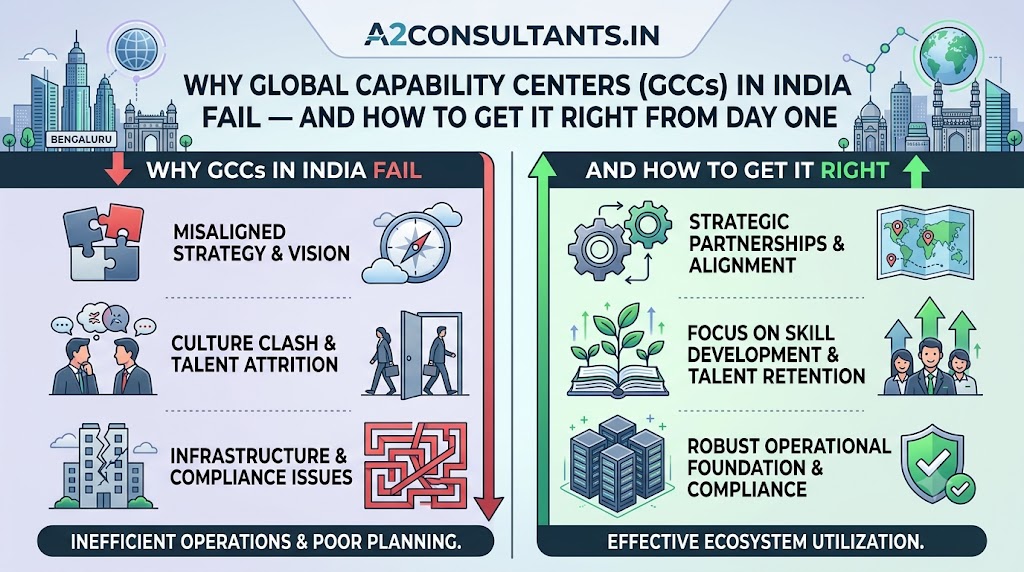
You can read our blog on GCC in india at https://www.a2consultants.in/blog-details/hyderabad-the-next-big-hub-for-gccs
(a) Manufacturing Relocation & Contract Manufacturing
European specialty chemical producers can:
- Shift production of intermediates to India
- Use Indian contract manufacturers
- Set up wholly-owned chemical plants
FTA benefits:
Lower tariffs on chemical imports
Improved market access
Harmonization of standards
Reduced supply chain cost
(b) Pharma Intermediates & Fine Chemicals
India is strong in:
- Key starting materials (KSMs)
- Fine chemicals
- Custom synthesis
European firms can:
- Secure long-term sourcing from India
- Invest in Indian chemical companies
- Develop custom molecules for EU markets
(c) ESG & Green Chemistry Advantage
India is rapidly upgrading:
- Environmental controls
- Zero liquid discharge plants
- Green chemistry processes
European companies can:
- Build ESG-compliant plants in India
- Meet EU sustainability rules
- Reduce carbon footprint by optimized logistics
4. Why European Companies Should Invest in India Post FTA
Key strategic drivers:
Large and compliant manufacturing base
Cost-efficient production
Skilled scientific workforce
API and chemical ecosystem
Government incentives
Export hub to Asia and Africa
FTA-driven tariff advantage
Supply chain diversification
Long-term market growth
India is no longer just a low-cost supplier — it is becoming a core manufacturing and innovation partner.
5. Entry Models for European Companies
European pharma and chemical companies can enter India through:
- Wholly owned subsidiaries
- Joint ventures with Indian manufacturers
- Contract manufacturing
- Technology licensing
- API and chemical plants
- R&D and testing centers
The choice depends on:
- Technology sensitivity
- Market strategy
- Investment scale
- IP protection
- Regulatory requirements
You can read Guide for setting up Subsidiary company at Guide for setting up Subsidiary / New company in India for Foreign Individual or Foreign company
6. Strategic Conclusion
The EU–India FTA will make India a strategic production base for pharmaceuticals, APIs, and specialty chemicals for European companies.
By establishing operations in India, European companies gain:
Cost advantage
Tariff benefit
Supply security
Regulatory alignment
Export flexibility
ESG compliance
Long-term competitiveness
For European pharmaceutical and chemical companies, India is not just a sourcing destination — it is becoming an integral part of their global value chain.
Looking to evaluate your pharmaceutical or chemical business expansion into India?
With deep experience in cross-border structuring, regulatory compliance, and India market entry, A2 Consultants advises European companies on investment structuring, tax optimization, and operational setup in India.
For detailed insights and practical guidance, visit our Knowledge Center and access our curated guides on India market entry: https://www.a2consultants.in/guides/india-market-entry-strategies-for-foreign-investors
Nagavarapu Sudheer is a veteran tax and regulatory consultant at A2 Consultants with over 24 years of experience. A fellow member of the Institute of Company Secretaries of India (F.C.S) with a background in Law (L.L.B) and Commerce (M.Com), he has specialized in FDI structuring and group corporate restructuring for Fortune 500 companies and global startups alike. https://in.linkedin.com/in/sudheer-nagavarapu-4225334b
Need a Structural Review of your business prospects in India? > If you are looking to pounce on the FTA opportunity and looking to review your business prospects . [Contact A2 Consultants for a Private Consultation as we have lot of European clients whom we are aleady helping in their business in India] https://www.a2consultants.in/home/book_slot