
EU-India FTA: Apparel Sourcing From India
Explore how the EU–India FTA makes India a better sourcing and manufacturing hub for European apparel companies compared to Bangladesh and Vietnam.
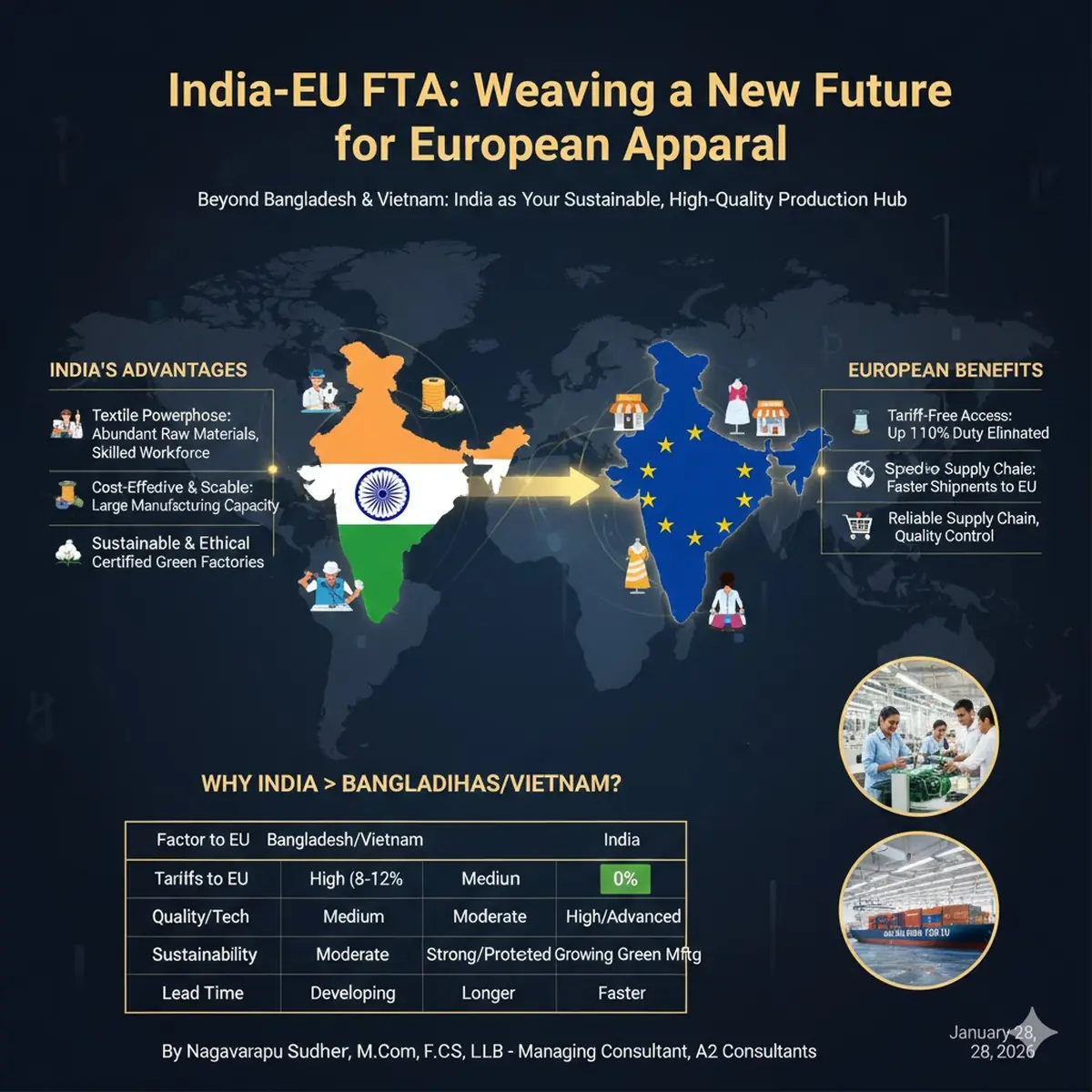
How the EU-India FTA Creates a Big Opportunity for European Apparel Companies ( Tariff of 8-12% reduced to zero now )
Why India Is Becoming now a Preferred Alternative to Bangladesh & Vietnam
By Nagavarapu Sudheer, M.Com, F.C.S, L.L.B Partner, A2 Consultants
The global apparel supply chain is undergoing a strategic transformation. For decades, European brands have relied on low-cost manufacturing hubs such as Bangladesh and Vietnam. However, a combination of rising labour costs in those countries, supply chain disruptions, higher compliance risk, and the prospect of a Free Trade Agreement (FTA) between the European Union and India is reshuffling global sourcing priorities and a 30 Billion export opportunity from India in coming years.
For European apparel manufacturers and brands, India is emerging as a strategic manufacturing and export destination — not just a low-cost option, but a value-driven partner in quality, scale, sustainability, and market diversity.
1. The EU–India FTA: A Game Changer in Textile & Apparel Trade
Once finalized, the EU–India Free Trade Agreement will eliminate or significantly reduce tariffs on textile and apparel products between the two markets.
Key Impacts:
- Reduction or elimination of import duties on Indian apparel exports to the EU
- Increased price competitiveness compared to Bangladesh, Vietnam and other third-country suppliers
- Improved predictability and legal certainty on trade rules
- Better access to the EU market for Indian manufactured garments
This means European companies can source garments from India cheaper, faster, and with full trade compliance, without duty penalties.
2. India’s Apparel Ecosystem: Scale Meets Quality
India is one of the world’s largest textile and apparel producers, with strengths across the value chain:
Yarn and fabric production
India ranks among the top global producers of cotton yarn, knitted fabric, and specialty textiles.
Vertical supply chain
Unlike Bangladesh and Vietnam (where most fabric is imported), India produces its own fibres and fabrics, reducing lead times and cost variability.
Large skilled workforce
India has deep experience in garment manufacturing, tailoring, embroidery, and technical textiles.
Technology adoption
Indian units increasingly use automation, RFID, PLM systems, and lean manufacturing.
For European brands, this means:
- Better control over quality
- Shorter lead times
- Lower logistics exposures
- Stronger traceability
3. Cost & Compliance Advantage vs Bangladesh & Vietnam
Traditionally, Bangladesh and Vietnam have been attractive primarily due to low labour costs. However:
Rising Costs
Labour cost inflation, quotas, and wage pressure have reduced the delta in overall landed cost.
Compliance & Risk
European buyers increasingly demand:
- Social compliance
- Environmental standards
- Traceability
- ESG reporting
India’s compliant manufacturing ecosystem, combined with FTA reduction in tariffs, makes it a safer sourcing partner for regulated European markets.
4. Sustainability & ESG Alignment
Europe is pushing firms toward Responsible Sourcing, including:
- Reduced carbon footprint
- Ethical labour practices
- Water stewardship
India ticks many boxes:
Large renewable energy pool
Local raw materials (cotton & sustainable fibres)
Growing adoption of waterless dyeing & eco-textiles
Third-party compliance infrastructure
This makes “Made in India” apparel more attractive to conscious European consumers and institutional buyers.
5. Export Hub Potential Beyond the EU
India’s strategic FTAs and trade negotiations (with UAE, UK, Australia and ASEAN markets) provide European brands an opportunity to build:
Regional export hubs
For:
- Middle East
- Africa
- South Asia
This spreads risk and enhances revenue diversification compared to Bangladesh/Vietnam, whose FTA networks are more limited.
6. Policy Support from Indian Government
India has introduced:
Production Linked Incentive (PLI) Scheme
PLI for textiles and apparel encourages:
- Capex expansion
- Technology upgrading
- Export competitiveness
Labour law reforms
Simplified labour codes make workforce management more predictable.
Ease of doing business
Online approvals, clear GST framework, state incentives
European firms can leverage these to build:
- Own manufacturing units
- Joint ventures with Indian manufacturers
- Design & R&D studios
7. Near-Shoring & Supply Chain Resilience
European apparel companies are seeking:
Supply diversification
Reduced lead times
Lower freight costs
More predictable deliveries
India’s geographic position and manufacturing scale make it ideal for:
Near-shoring or dual-sourcing strategies.
This significantly improves resilience compared to:
- Overdependence on one country
- Delays in seaports
- Container cost volatility
- Pandemic or geopolitical shocks
8. Digital & E-Commerce Integration
India has one of the world’s largest digital consumer bases. This fuels:
- Online fashion demand
- Direct-to-consumer launches
- Data-driven inventory management
European firms launching India-specific brands can tap:
Rapid urbanization
App-based shopping
Cashless payments
This adds a market expansion angle beyond just manufacturing/export.
9. Comparative Advantages: India vs Bangladesh & Vietnam
Why European Apparel Companies Should Act Now
The apparel industry is shifting beyond low labour cost sourcing to a mix of:
Tariff advantage
Quality assurance
Compliance security
Sustainability credentials
Supply chain resilience
With the EU–India FTA, India is no longer just another source — it is becoming a strategic partner for European brands in:
Manufacturing
Market access
ESG compliance
Export diversification
European companies that enter, invest, and integrate with India now will reap long-term competitive advantage — not only relative to Bangladesh and Vietnam, but also as leaders in the future of global apparel commerce.
For detailed insights and practical guidance, visit our Knowledge Center and access our curated guides on India market entry: https://www.a2consultants.in/guides/india-market-entry-strategies-for-foreign-investors
Nagavarapu Sudheer is a veteran tax and regulatory consultant at A2 Consultants with over 24 years of experience. A fellow member of the Institute of Company Secretaries of India (F.C.S) with a background in Law (L.L.B) and Commerce (M.Com), he has specialized in FDI structuring and group corporate restructuring for Fortune 500 companies and global startups alike. https://in.linkedin.com/in/sudheer-nagavarapu-4225334b
Need a Structural Review of your business prospects in India? > If you are looking to pounce on the FTA opportunity and looking to review your business prospects . [Contact A2 Consultants for a Private Consultation as we have lot of European clients whom we are aleady helping in their business in India] https://www.a2consultants.in/home/book_slot