
India DTAA Guide 2026: Holding Structures
India's DTAA network compared: Mauritius, Singapore, UAE and more, plus what GAAR, PPT and substance rules mean for holding companies.
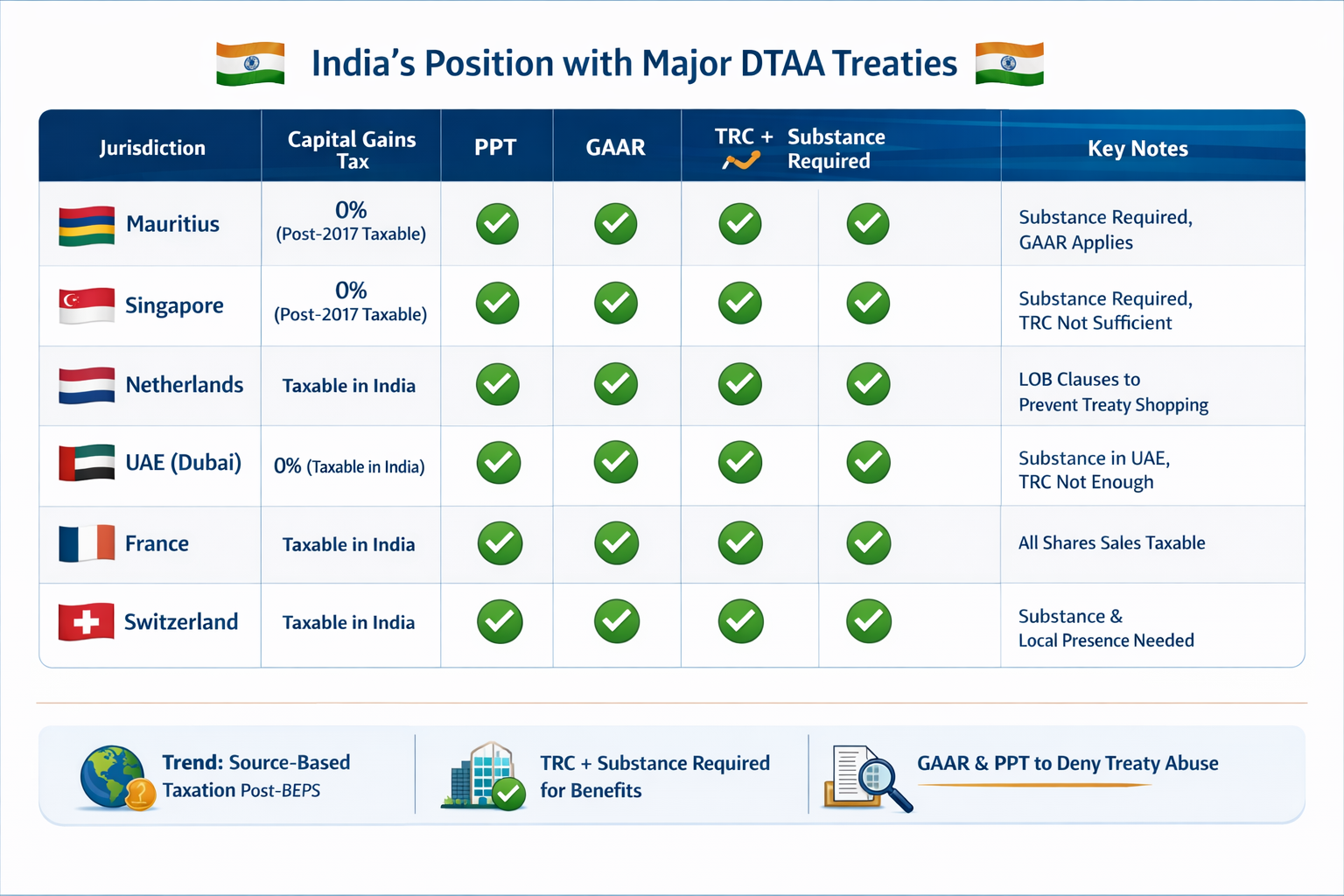
Comparison of India’s Position with Other Major DTAA Treaties after Tiger global Supremecourt Judgement
By Nagavarapu Sudheer, M.Com, F.C.S, L.L.B Partner, A2 Consultants
India–Mauritius DTAA
- Historically zero capital gains tax on share sales routed via Mauritius because Mauritius did not tax capital gains, making it a popular conduit for FDI into India.
- 2016/17 amendments gave India the right to tax capital gains on investments made after 01/04/2017.
- Following the Tiger Global ruling, India can deny treaty benefits where the structure is abusive or lacks substance, even if a Tax Residency Certificate (TRC) exists.
- The Principal Purpose Test (PPT) has been introduced to deny benefits where tax advantage is a main purpose.
Key India Mauritius Notes:
Treaty benefits not automatic
Substance requiredf
GAAR can override DTAA benefits.
India–Singapore DTAA
Like Mauritius, Singapore was also used as a treaty conduit for FDI due to favorable capital gains treatment.
- After treaty changes, India can tax capital gains arising from share transfers post 01/04/2017.
Similarities to Mauritius:
PPT applies
Substance standards increasingly required
No automatic relief based solely on TRC
India–Netherlands DTAA
- Traditionally standard OECD model based — India retains the right to tax capital gains on shares of Indian companies if substantial value is from India.
- Unlike the older Mauritius regime, Netherlands treaty never provided blanket capital gains exemption for investors.
Key Differences:
Less “conduit/misuse” advantage
Capital gains rights more source based
LOB clauses common to curb treaty shopping
India–France (Revised)
- Recent revision reduced dividend tax but expanded India’s capital gains taxing rights, making all share sales in India taxable regardless of threshold.
- Highlights a global trend: treaties being updated to balance investor relief with sovereign taxing rights.
Takeaway:
While treaties vary, a common global norm post BEPS/MLI is:
Capital gains rights tend to reside with source country,
Treaty benefits conditioned on substance and commercial rationale.
India–UAE (Dubai/Abu Dhabi) DTAA
- The UAE (including Dubai) is a popular holding jurisdiction due to zero capital gains tax and a flexible corporate environment.
- Treaty allows reduced withholding taxes on dividends, interest, and royalties, but capital gains from shares are taxable in India if the UAE entity lacks commercial substance.
- India now requires substance and economic reality, consistent with PPT and GAAR principles, to grant treaty benefits.
Key Notes:
TRC is necessary but not sufficient
Substance includes employees, office, and decision-making in UAE
Popular for PE/VC structuring, but must comply with BEPS/MLI norms
India–Switzerland DTAA
- Switzerland used for holding structures and family offices.
- Provides reduced withholding taxes but capital gains from Indian shares remain taxable if Swiss entity is a shell.
- Substance requirements include local employees, real office, and decision-making, similar to Mauritius and Singapore.
2) Checklist for Foreign Investors Building Treaty Based Holding Structures
To ensure DTAA benefits hold up under scrutiny — especially in India — investors should follow this checklist:
Legal and Structural Requirements
- Valid Tax Residency Certificate (TRC) from the holding jurisdiction.
- Proper incorporation and compliance with local company law (e.g., actual registered office).
- Limitation on Benefits (LOB) clause compliance if the treaty includes it (to avoid treaty shopping).
Substance & Operational Requirements
- Genuine board meetings with majority of directors physically participating in the treaty jurisdiction.
- Local decision making authority – strategic, financial, and investment decisions documented and taken locally.
- Real employees and payroll in the treaty jurisdiction.
- Local bank accounts and operational costs commensurate with economic activity.
- Commercial rationale beyond tax savings (e.g., business purpose for holding entity).
Why substance matters:
India now examines substance and rejects reliance on TRC alone where arrangements are primarily tax motivated.
Documentation & Record Keeping
- Minutes of meetings, evidence of decision making, strategic planning.
- Audit trails showing cash flows in and out of the entity.
- Evidence of commercial interactions (contracts, employee timesheets, office leases).
Tax & Treaty Compliance
- Advance Pricing Agreements (APAs) or Advance Rulings where appropriate.
- Regular legal audits to assess treaty eligibility under evolving BEPS/GAAR norms.
- Tax opinion letters supporting the structure’s commercial purpose.
- Review of treaty updates and MLI impacts regularly.
3) Practical Case Studies: Compliant vs Non Compliant Structures
Case A: Compliant Treaty Structure
Scenario:
A Singapore holding company legitimately runs its investment operations from Singapore and holds Indian portfolio investments.
Features:
Local Singapore employees and office space
Board meetings conducted in Singapore
Decisions on acquisitions, capital allocation, exits made by Singapore directors
Documented commercial strategy beyond tax
Outcome:
Strong defense against GAAR/PPT tests because substance, economic activity, and commercial rationale exist — not just a superficial shell.
Result:
Investor likely retains treaty benefits under India–Singapore DTAA (e.g., reduced withholding tax).
Key point: Token residency isn’t enough — actual business presence is required.
Case B: Non Compliant “Shell” Treaty Structure
Scenario:
A Mauritius entity incorporated solely as a conduit for tax benefit, with no real local operations, few or no employees, and strategic decisions taken abroad.
Features:
TRC obtained but no real substance
Board meetings held virtually from another jurisdiction
No local office, no payroll
Investment decisions documented elsewhere
Outcome:
Under India’s Tiger Global decision and GAAR/PPT doctrine, benefits denied because entity lacks commercial substance.
Result:
Capital gains taxed in India despite the treaty; investor faces tax plus interest/penalties.
Key point: Substance > documentation — legal form cannot replace economic reality.
Case C: Partial Compliance with Weak Documentation
Scenario:
A Cyprus holding company has an office lease and a couple of employees but major decisions are made by parent company executives overseas; limited evidence of local decision making.
Risk Factors:
• Weak evidence of board deliberations locally
• Major financial decisions by non resident managers
Outcome:
Tax authority may argue entity lacks effective management in treaty jurisdiction and deny treaty benefits.
Lesson:
Substance is not just paperwork — it must reflect real economic control locally.
Key Takeaways for Investors
Treaty reliance must be backed by substance — not just TRC or incorporation.
India and other countries now apply PPT/GAAR standards that allow denial of benefits if primary purpose is tax advantage.
Documentation/operations must demonstrate real business activities and decision making in the treaty jurisdiction.
Regular review of treaties, BEPS measures, and local case law is essential — treaty norms are evolving globally.
For detailed insights and practical guidance, visit our Knowledge Center and access our curated guides on India market entry: https://www.a2consultants.in/guides/international-taxation-in-india-for-foreign-companies
Nagavarapu Sudheer is a veteran tax and regulatory consultant at A2 Consultants with over 24 years of experience. A fellow member of the Institute of Company Secretaries of India (F.C.S) with a background in Law (L.L.B) and Commerce (M.Com), he has specialized in FDI structuring and group corporate restructuring for Fortune 500 companies and global startups alike. https://in.linkedin.com/in/sudheer-nagavarapu-4225334b
Need a Structural Review of your business prospects in India? > If you are looking to pounce on the FTA opportunity and looking to review your business prospects . [Contact A2 Consultants for a Private Consultation ] https://www.a2consultants.in/home/book_slot